Volvo is banking hard on its new EX30 Cross Country, expecting the mild off-road variant to grab around a third of total model sales when it hits showrooms in the coming weeks.
The Swedish brand has such faith in the soft-roader that it plans replacing the dual motor variant entirely, leaving just the Cross Country and single motor in the lineup.
The EX30 small electric SUV arrived in Australia in early 2024 with three variants: two single-motor versions and a top-of-the-range dual-motor.
The Cross Country slots in the middle of the range but shares specifications with the twin motor model, adding 19mm raised ride height, larger diameter tires, and optional 18-inch wheels with all-terrain rubber.
Suspension gets retuned to match the increased ride height, providing softer ride quality for rougher terrain. Styling differences include front and rear skid plates, wheel arch extensions, and dark finish for the front panel and tailgate applique.
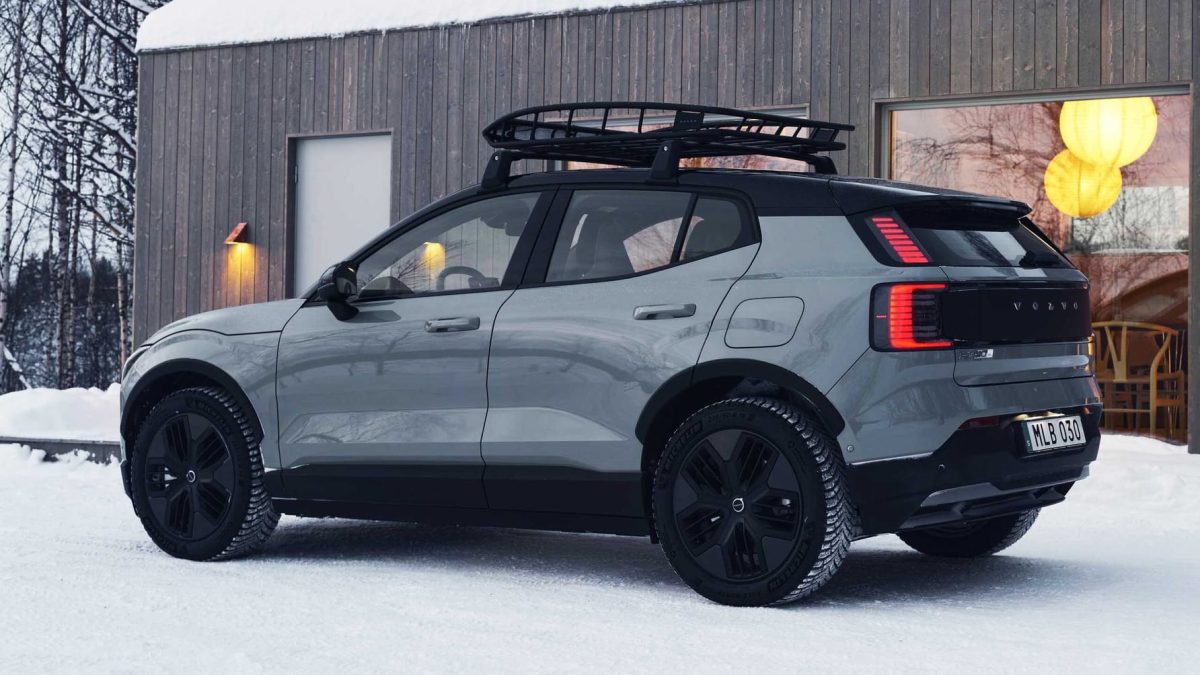
The front features a stylized topographical map of the Kebnekaise mountain range in Arctic Sweden with longitude and latitude coordinates pointing to the Toppstugan emergency accommodation cabin, Sweden’s highest building.
According to Volvo Australia’s Managing Director, Stephen Connor, Australians love having the option to go off-road even if they rarely do.
Most buyers choose SUVs for their rugged look, extra ground clearance, and twin-motor capability, which ticks all the right boxes.
The vehicle handles gravel roads, driveways, and property use including creek crossings rather than mountain climbing. Its capabilities suit practical needs without pretending to match serious 4x4s.
Volvo initially expected the twin motor would be the biggest seller versus single motor, targeting younger buyers. Reality proved different.
Buyers are predominantly fifties to eighties downsizing from larger vehicles, less worried about performance and more concerned about EV charging infrastructure and lower pricing.
Michael Rowland, Product Manager for Volvo Australia, told media the brand shifted its all-wheel drive offering to the Cross Country as the new flagship.
Once current twin motor stock sells through, the Cross Country becomes top of the range alongside the single motor variant.
The strategy shift reflects evolving understanding of EV buyer demographics. Older customers prioritize practicality over acceleration, seeking capable vehicles without the premium pricing or performance focus that younger buyers demand.
At $45,950, the Cross Country costs $850 less than the Twin Motor Performance Ultra but $2,430 more than the Single Motor Extended Ultra. The pricing positions it as an accessible flagship rather than an expensive halo model.
The EX30 Cross Country marks the first EV and SUV to wear the Cross Country nameplate introduced in the 1990s for Volvo sedans and wagons. Reviving the badge for electric SUV signals the brand’s confidence in the format’s future relevance.
Volvo expects around 600 Cross Country sales annually, representing significant volume for a niche variant in the small premium EV segment.
Whether those projections prove accurate depends on older buyers embracing electric mobility at the rate Volvo anticipates.
The gamble shows Volvo willing to make bold lineup decisions based on emerging data rather than sticking with original launch plans.
Replacing the performance-focused dual motor with a practical Cross Country demonstrates flexibility rarely seen from legacy automakers.