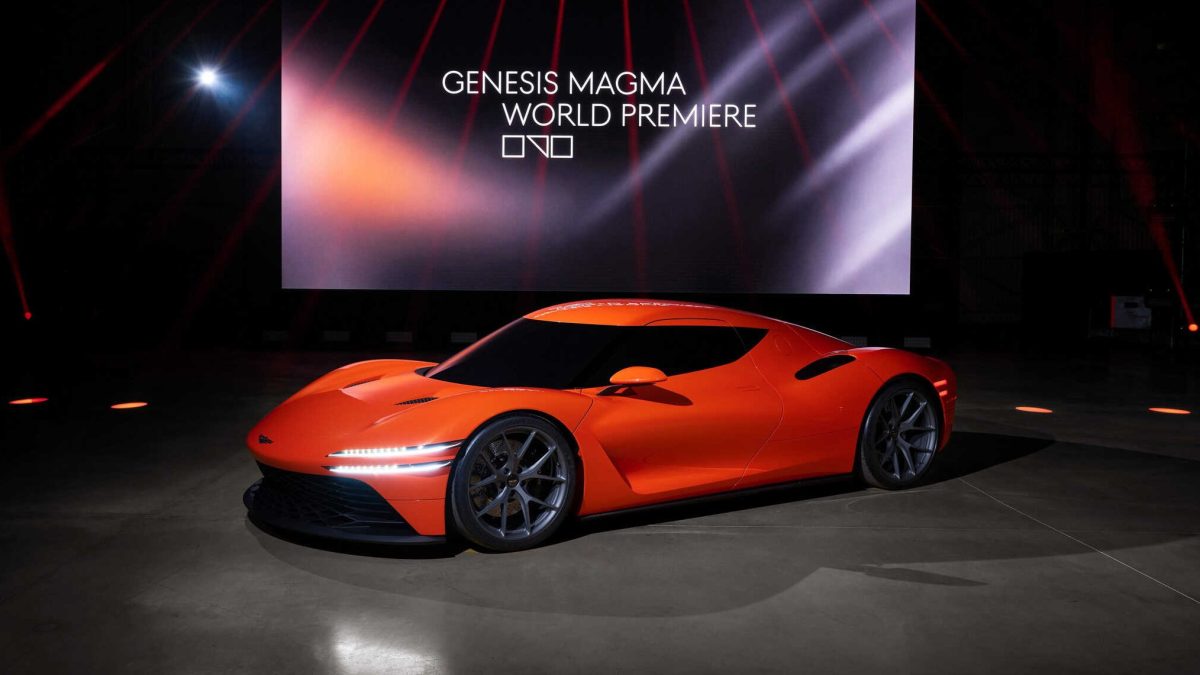
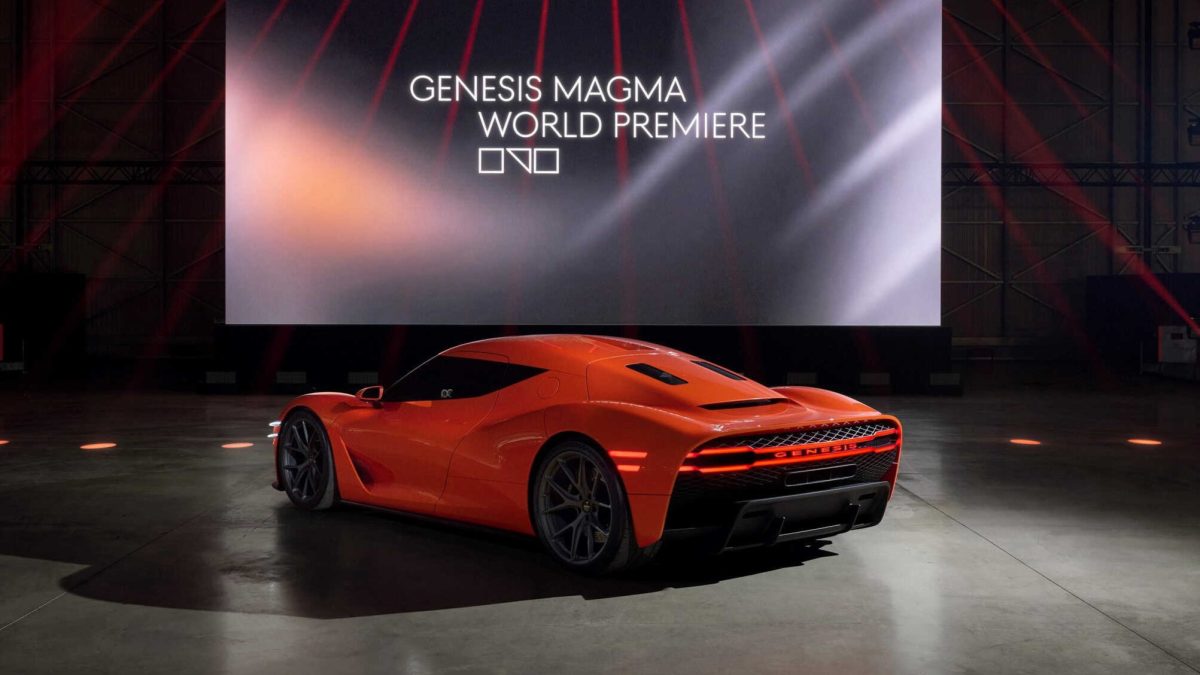
Genesis just threw down the gauntlet in supercar territory. The Korean luxury brand unveiled its Magma GT Concept in France, and this is no vaporware showcar.
It’s a genuine preview of a mid-engine V8 monster set to arrive around 2028 or 2029.
The reveal came at the official launch of the GV60 Magma, the first in Genesis’s new performance sub-brand.
Creative chief Luc Donckerwolke called the GT “the clearest expression yet” of the brand’s commitment to proper motorsport capability. In other words, we can say that Genesis is no longer playing it safe.
The concept packs a turbocharged 3.2-litre V8 derived from the engine powering Genesis’s GMR-001 Le Mans hypercar.
That racing pedigree matters. The production car will ride on an aluminium monocoque chassis rather than carbon fibre, keeping costs sensible while performance stays savage.
Expect the V8 to send power rearward through an eight-speed dual-clutch transmission, with some form of electrification helping meet emissions standards.
But here’s where it gets interesting. Genesis isn’t building just one supercar. Donckerwolke confirmed a complete product lifecycle inspired by Porsche’s 911 playbook.
Start with the base car, then roll out an S variant, GTS, roadster, lightweight club sport edition, GT3 road car, and GT3 R track weapon. It’s a full family tree of speed.
The GT3 racing angle is crucial. Genesis plans to homologate the Magma GT for GT3 competition and sell race-spec versions to private teams.
Former Renault F1 boss Cyril Abiteboul, now heading Hyundai Motorsport, will likely oversee the racing program.
GT3 regulations require 250 road-legal cars for homologation, but Genesis plans higher production numbers to make the business case work.
Donckerwolke admits the concept design is “a bit safe” and wants the production version to be more polarising.
The signature Genesis dual-light graphic stays, along with the greenhouse design referencing the GMR-001 hypercar.
Despite the racing DNA, Donckerwolke promises the Magma GT won’t be a handful. “It won’t ask the driver to improve their skill. It will enhance it,” he said.
The timing connects to Genesis’s broader motorsport push. The brand enters the World Endurance Championship this year with its Le Mans hypercar, joins IMSA in 2027, then likely launches GT3 racing after that.
Americans should pay attention. The US remains Hyundai Motor Group’s biggest market through 2030, and Americans buy more mid-engine supercars than anyone.
Honda’s NSX and Chevy’s C8 Corvette proved mainstream brands can win in this space if the driving thrills deliver.
Genesis is betting on a 14-year platform life with constant variant drops to stay profitable.
It’s not rocket science, just smart product planning borrowed from the Italian playbook.
Ferrari and Lamborghini make serious money on GT3 programs through customer racing sales and support. Genesis wants that action too.
The Korean brand pitching into supercar wars would have seemed laughable a decade ago.
Now, with legitimate motorsport credentials and Donckerwolke’s Lamborghini design experience, the Magma GT looks like the real deal. The battlefield just got more crowded.