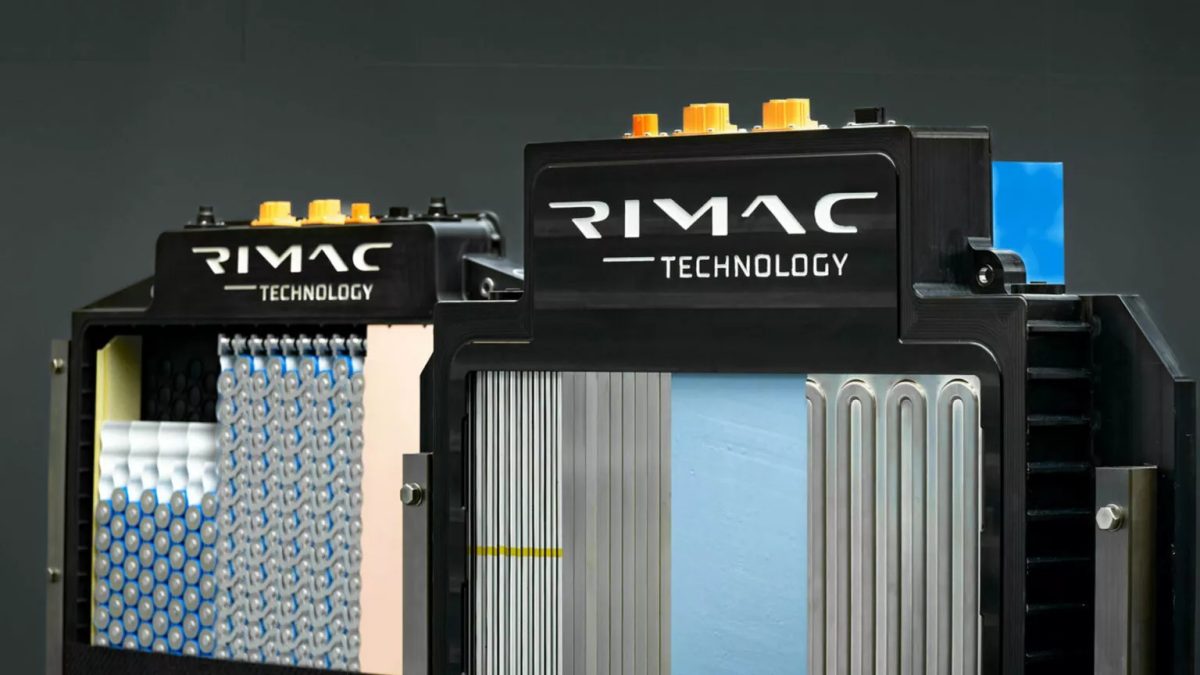
Rimac Technology has developed a solid-state EV battery that could redefine charging standards. The next-generation power pack charges from 10 to 80% in just 6.5 minutes using fast charging infrastructure, faster than most people spend filling a gas tank.
Developed in partnership with ProLogium and Mitsubishi Chemical Group, the breakthrough battery delivers high voltage with enhanced fire safety while packing more power into less space. Energy density reaches 260 Wh/kg in a 100 kWh capacity package that retains over 95% capacity even in extreme cold conditions.
The design uses cell to pack architecture with indirect refrigerant cooling, achieving remarkable power density in a compact, lightweight format compared to traditional battery systems. Rimac positions the technology as production-ready rather than concept stage, capable of powering hundreds of thousands of vehicles in the coming years.
The Croatian company showcased the battery at the Munich motor show alongside additional powertrain components, including e-axles and near-term battery options. An Evo battery arrives mid 2026 with 100 kWh capacity but lower 213 Wh/kg energy density and slower 16-minute charging from 10 to 80%.
Rimac also revealed hybrid battery solutions, including a scalable unit launching early next year with capacity ranging from 1 to 17 kWh. The company emphasized interchangeable cell configurations and integrated cell-to-pack architecture with advanced safety and thermal management features.
Two new e-axles join the lineup, targeting performance-focused vehicles from hot hatches to SUVs. The Sinteg 300 and 550 units produce between 201 and 483 horsepower, with the 550 variant entering production next year.
Rimac Technology COO Nurdin Pitarević emphasized these aren’t simply concept technologies but production-ready solutions developed for real-world deployment. The company supplies multiple automakers including BMW and Porsche, positioning itself as a key technology partner rather than direct competitor.
The solid-state battery debuts in high-performance EVs from Q4 2027, marking a significant leap in charging convenience and energy efficiency. Six and a half minute charging times could eliminate range anxiety arguments that plague current EV adoption, assuming charging infrastructure scales to support the technology.
Traditional lithium-ion batteries require 30 to 45 minutes for similar charging levels, even on the fastest DC systems. Rimac’s breakthrough cuts that time by over 75%, bringing EV charging times below what many drivers spend at gas stations when accounting for payment processing and fueling.
The technology could transform EV adoption by removing the charging time disadvantage compared to combustion vehicles. Whether charging infrastructure providers can deploy enough 350kW+ stations to support widespread use remains the critical question.